Daylight saving time 2026

Winter time 2026
Sunday, 25 October 2026
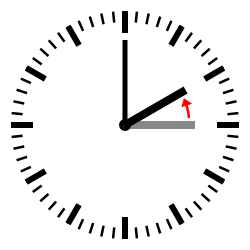
On Sunday, 25 October 2026, clocks move back one hour at 3:00 AM to 2:00 AM.
That day is 25 hours long.
Winter time, or standard time, is the time observed outside of the summer period. The seasonal clock change was coordinated across Europe in 1996 to avoid cross-border confusion. The European Parliament voted in 2019 to abolish the clock change, but implementation has been postponed indefinitely.
Practical tips
You gain an hour of sleep, but it gets dark earlier in the evening. Adjust analogue clocks, ovens and car clocks manually. Public transport runs an adjusted schedule that night. Make a point of getting extra daylight in the days that follow.
Upcoming dates for Winter time
| Date | Day |
|---|---|
| 2026 | Sunday, 25 October 2026 |
| 2027 | Sunday, 31 October 2027 |
| 2028 | Sunday, 29 October 2028 |
| 2029 | Sunday, 28 October 2029 |
| 2030 | Sunday, 27 October 2030 |
Summer time 2026
Sunday, 29 March 2026
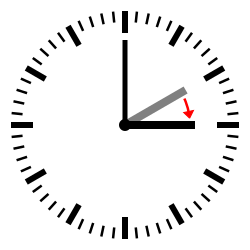
On Sunday, 29 March 2026, clocks move forward one hour at 2:00 AM to 3:00 AM.
That day is only 23 hours long.
Daylight saving time was first introduced in Europe during the First World War as an energy-saving measure. The practice was standardised across the European Union in 1996, with all member states changing their clocks on the same date. The European Parliament voted in 2019 to abolish the seasonal clock change, but implementation has been postponed indefinitely.
Practical tips
Go to bed a little earlier the night before to offset the lost hour. Smartphones and laptops adjust automatically, but analogue clocks, ovens and car clocks need to be changed manually. Public transport runs an adjusted schedule that night.
Upcoming dates for Summer time
| Date | Day |
|---|---|
| 2026 | Sunday, 29 March 2026 |
| 2027 | Sunday, 28 March 2027 |
| 2028 | Sunday, 26 March 2028 |
| 2029 | Sunday, 25 March 2029 |
| 2030 | Sunday, 31 March 2030 |